
DroneBeacon MAVLink/DroneCAN modules add Remote ID to your drone through its autopilot. They connect to ArduPilot or PX4 over MAVLink or DroneCAN, broadcast Remote ID at high transmit power for long range, and report their status to the GCS (QGroundControl, Mission Planner). They are designed for drone manufacturers, system integrators and DIY builders of FAA Standard Remote ID drones.
The db300 is approved on the U.S. DoD Blue UAS Framework (10 July 2026) and is fully NDAA compliant, including Section 848. For government, defense and other NDAA-restricted projects, it's the module to use. The db201, db202mav, db203can and db210pro run the open-source ArduRemoteID firmware and are the cost-effective choice for commercial projects.
All modules comply with ASTM F3411-22a (the FAA-accepted means of compliance) and ASD-STAN EN 4709-002, and use FCC/CE certified radio modules. Because the module is built into your drone, you as the manufacturer submit the FAA Declaration of Compliance (DoC). We can support you with that. Need an FAA-accepted add-on that works without the autopilot? Use a DroneBeacon broadcast module instead.
Products
db300
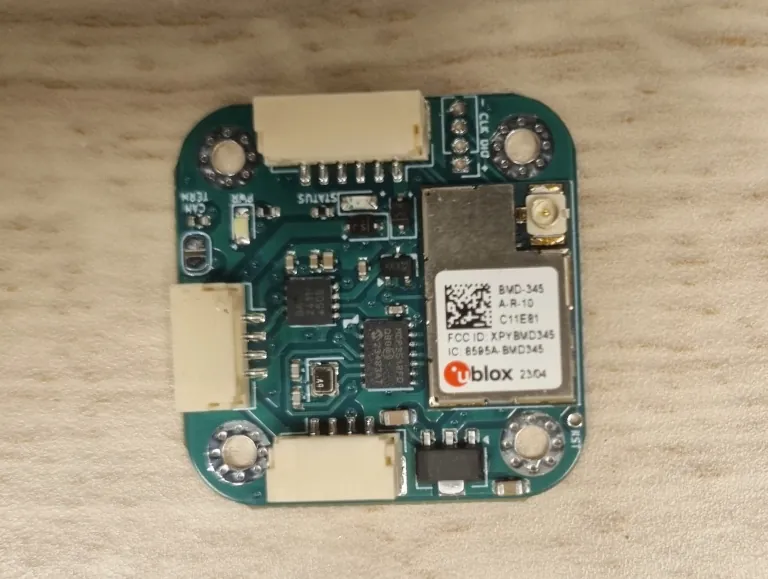
Blue UAS approved module. For most customers this is the best choice due to new US regulation. Specifications
db201
the best choice if you do not need a Blue UAS approved module. Specifications
db202mav
a cost effective solution with one MAVLink port. Specifications
db203can
db203can: a cost effective solution with one DroneCAN port. Specifications
db210pro
db210pro: a feature-rich solution with the powerful ESP32-S3 chip Specifications
Blue UAS and NDAA compliance
The Blue UAS program of the U.S. Department of Defense (also called the Department of War) vets drones and drone components for government use. It covers NDAA compliance plus cybersecurity and supply-chain security. Only the DoD can approve drones or components. The program keeps two lists: the Blue UAS Cleared List for complete drone systems, and the Blue UAS Framework for approved components and software.
The db300 is approved on the Blue UAS Framework (10 July 2026). You can verify it on the official Framework List (search for "db300").
Two sections of the U.S. National Defense Authorization Act (NDAA) apply to Remote ID modules:
- Section 848 (FY2020 NDAA), as amended: prohibits drones and drone components, such as radios and data transmission devices, made in or sourced from covered foreign countries. It applies to Remote ID modules because they are built into the drone.
- Section 889 (FY2019 NDAA): prohibits telecommunications and video surveillance equipment from restricted vendors. This is a general section, not specific to drones.
| Module | Radio | Section 889 | Section 848 | Blue UAS |
|---|---|---|---|---|
| db300 | u-blox BMD-345 (Nordic nRF52840) | Yes | Yes | Approved |
| db201, db202mav, db203can, db210pro | Espressif ESP32 (China) | Yes | No | No |
For the db300, the DoD has independently verified NDAA compliance as part of the Blue UAS approval. For the other modules, Section 889 compliance is a manufacturer declaration by BlueMark Innovations BV. Using Blue UAS Framework components doesn't make a complete drone Blue UAS cleared: the drone itself must be submitted separately.
Standard Remote ID vs Remote ID broadcast module
The FAA (USA) defines two ways to comply with Remote ID:
- Standard Remote ID drone: Remote ID is built into the drone and integrated with the autopilot. The drone manufacturer submits a Declaration of Compliance. The pilot sees the Remote ID status in the GCS and gets a warning if it fails. The Remote ID rule doesn't limit these drones to visual line of sight. BVLOS flights still need separate FAA authorization.
- Remote ID broadcast module: a stand-alone, FAA-accepted add-on for drones without built-in Remote ID. It doesn't communicate with the drone, and the drone must stay within visual line of sight (VLOS).
DroneBeacon MAVLink/DroneCAN modules are for Standard Remote ID drones. The EU has only one Direct Remote ID category, and the modules also comply with its standard, ASD-STAN EN 4709-002. (Manufacturers need to make sure they comply with each requirement. Sometimes a Remote ID broadcast module can be a better solution.)


Certified manufacturing
The DroneBeacon MAVLink/DroneCAN product family are produced with high quality and environmental standards:

FAA ready
Open source
Which Remote ID module should I buy?
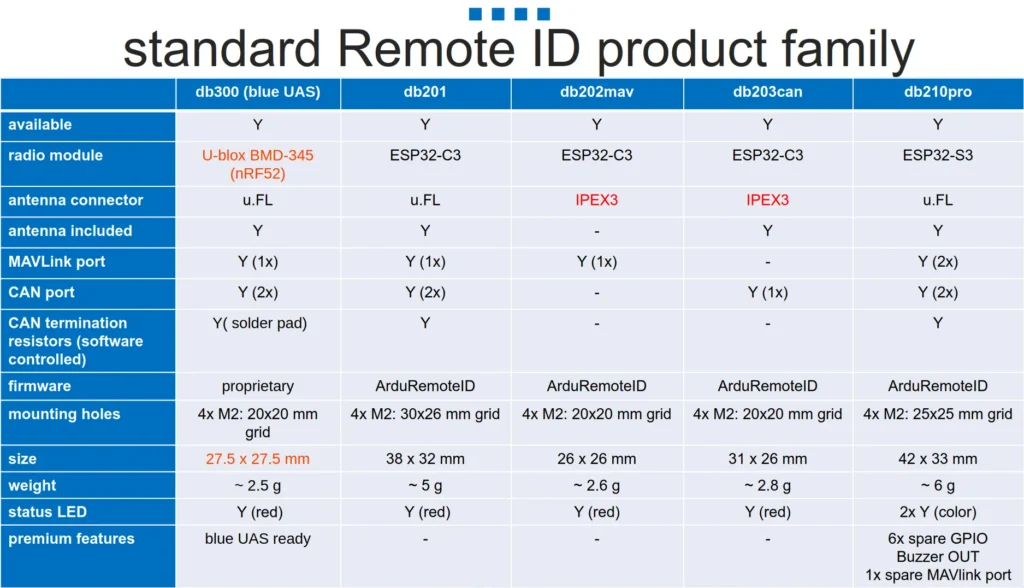
- Government, defense or NDAA-restricted projects: db300. It's the only Blue UAS approved, fully NDAA compliant module in the range, with the same ports as the db201.
- Commercial drones, MAVLink and DroneCAN: db201. Open-source ArduRemoteID firmware, Bluetooth and Wi-Fi.
- Lowest cost, MAVLink only: db202mav.
- Lowest cost, DroneCAN only: db203can.
- Extra ports, GPIO and processing power: db210pro (ESP32-S3).
| Model | Ports | Broadcast | Firmware | NDAA | Blue UAS | Size / weight | Price* |
|---|---|---|---|---|---|---|---|
| db300 | 2× DroneCAN, 1× MAVLink | Bluetooth 4 Legacy + 5 Long Range | BlueMark (ArduRemoteID-compatible) | 848 + 889 | Approved | 27.5 × 27.5 mm, 2.5 g | €69 |
| db201 | 2× DroneCAN, 1× MAVLink | Bluetooth 4 Legacy + 5 Long Range, Wi-Fi | ArduRemoteID (open source) | 889 only | No | 38 × 32 mm, 5 g | €40 |
| db202mav | 1× MAVLink | Bluetooth 4 Legacy + 5 Long Range, Wi-Fi | ArduRemoteID (open source) | 889 only | No | 26 × 26 mm, 2.6 g | €29 |
| db203can | 1× DroneCAN | Bluetooth 4 Legacy + 5 Long Range, Wi-Fi | ArduRemoteID (open source) | 889 only | No | 31 × 26 mm, 2.8 g | €35 |
| db210pro | 2× DroneCAN, 2× MAVLink, 6 GPIO | Bluetooth 4 Legacy + 5 Long Range, Wi-Fi | ArduRemoteID (open source) | 889 only | No | 42 × 33 mm, 6 g | €60 |
* Excl. VAT, October 2026. Sizes without antenna. All modules are powered with +5 V from the TELEM or CAN port and comply with ASTM F3411-22a and ASD-STAN EN 4709-002.
Specifications
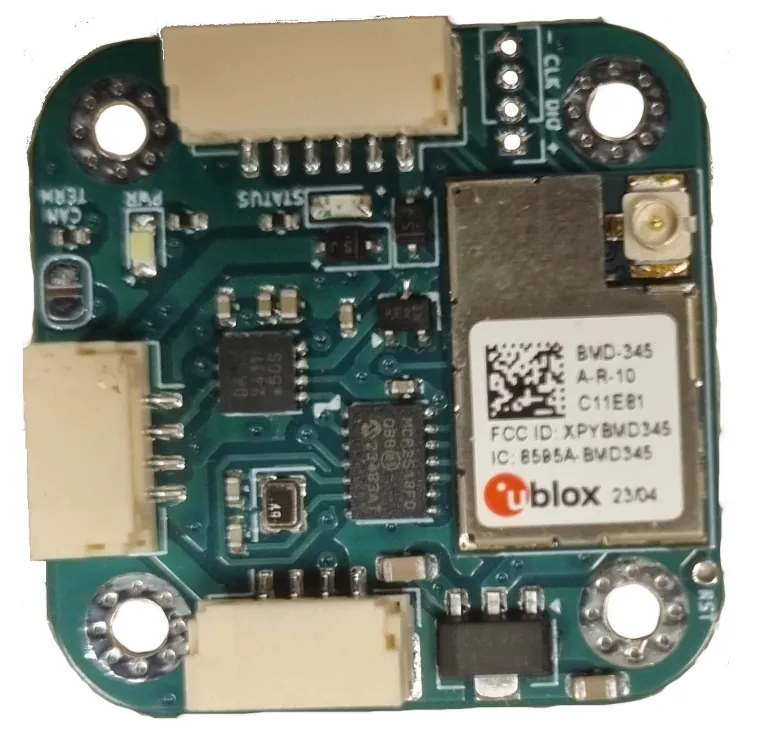
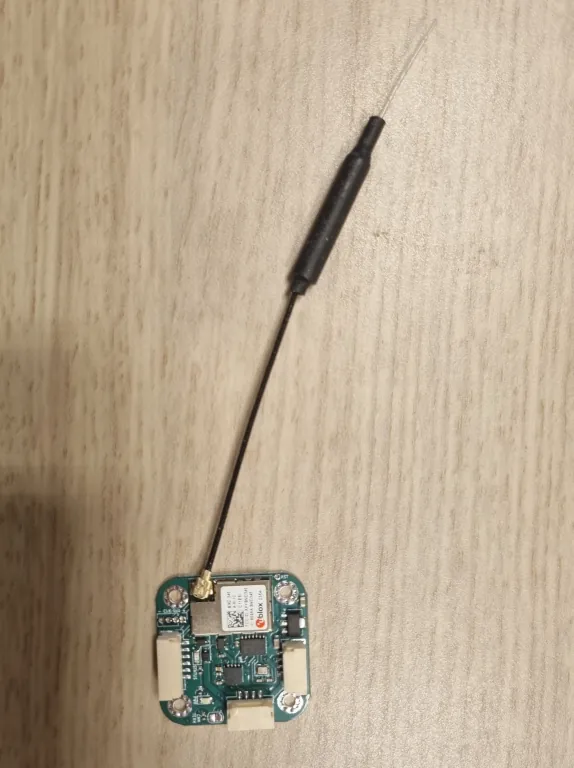
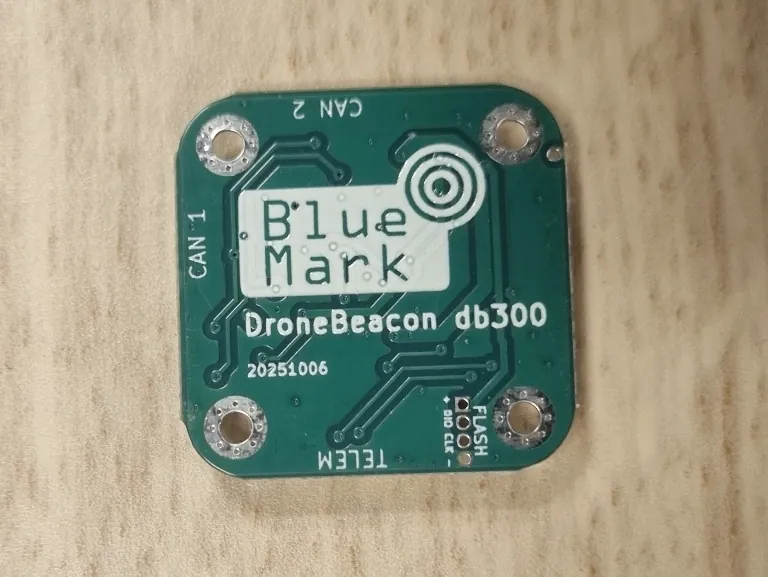
DroneBeacon db300 — Blue UAS approved Remote ID module 

Blue UAS approved (Framework, 10 July 2026). Software drop-in for the db201 for most users.
Short-range radio
Bluetooth dual-mode (Bluetooth 4 Legacy + Bluetooth 5 Long Range). External PA, +18 dBm (FCC certified), +20 dBm EIRP (100 mW) with the included 2 dBi antenna
FCC/CE certified radio module (nRF52 based) FCC ID: XPYBMD345
NDAA compliant
Yes (Sections 848 and 889, verified by Blue UAS approval)
Blue UAS
Approved (Framework, 10 July 2026)
Antenna
2 dBi omni-directional antenna (IPEX connector) included
Power
+5V supplied from TELEM or CAN port
Firmware
proprietary firmware, supports OTA firmware upgrade using Bluetooth or programming using SWD interface
Connectivity
2x JST GH 4-pin CAN (DroneCAN) port (CAN 2.0 + CAN FD up to 8 Mbps) 
1x JST GH 6-pin TELEM (MAVLink, UART) port 
LED lights
power and status LED
CAN termination resistors
yes (solder pad)
Fastening mechanism
4x M2 screws (20 x 20 mm grid)
IP rating
none
Operating temperature
-40 °C to 85 °C
Dimensions
27.5 x 27.5 x 5 mm (without antenna)
Weight
2.5 grams (without antenna)
DroneBeacon db201 transponder
Best choice for most users if you do not need a Blue UAS approved module.
Short-range radio
Bluetooth 4 Legacy + Bluetooth 5 Long Range, Wi-Fi Beacon/NaN (2.4 GHz), output power (EIRP): + 20 dBm (100 mW)
FCC/CE certified radio module (ESP32C3 based) FCC ID: 2AC7Z-ESPC3WROOMU
NDAA compliant
No, it meets Section 889 only.
Blue UAS
No
Antenna
2 dBi omni-directional antenna (IPEX connector) included
Power
+5V supplied from TELEM or CAN port
Firmware
open source ArduRemoteID, supports OTA firmware upgrade via the web interface
Connectivity
2x JST GH 4-pin CAN (DroneCAN) port
1x JST GH 6-pin TELEM (MAVLink, UART) port
LED lights
power and status LED
CAN termination resistors
yes (software controlled)
Fastening mechanism
4x M2 screws
IP rating
none
Operating temperature
-40 °C to 85 °C
Dimensions
38 x 32 x 5 mm (without antenna)
Weight
5 grams (without antenna)


DroneBeacon db202mav transponder
Cost-effective solution with only 1 MAVLink port.
Short-range radio
Bluetooth 4 Legacy + Bluetooth 5 Long Range, Wi-Fi Beacon/NaN (2.4 GHz), output power (EIRP): + 20 dBm (100 mW)
FCC/CE certified radio module (ESP32C3 based) FCC ID: 2AC7Z-ESPC3MINII
NDAA compliant
No, it meets Section 889 only.
Blue UAS
No
Antenna
no antenna provided. The antenna connector is IPEX3 (not u.FL) An IPEX3 antenna can be bought here (or Adafruit).
Power
+5V supplied from TELEM port
Firmware
open source ArduRemoteID, supports OTA firmware upgrade via the web interface
Connectivity
1x JST GH 6-pin TELEM (MAVLink, UART) port
LED lights
power and status LED
Fastening mechanism
4x M2 screws: 20 x 20 mm grid
IP rating
none
Operating temperature
-40 °C to 85 °C
Dimensions
26 x 26 x 5 mm (without antenna)
Weight
2.6 grams (without antenna)


DroneBeacon db203can transponder
Cost-effective solution with only 1 DroneCAN port.
Short-range radio
Bluetooth 4 Legacy + Bluetooth 5 Long Range, Wi-Fi Beacon/NaN (2.4 GHz), output power (EIRP): + 20 dBm (100 mW)
FCC/CE certified radio module (ESP32C3 based) FCC ID: 2AC7Z-ESPC3MINII
NDAA compliant
No, it meets Section 889 only.
Blue UAS
No
Antenna
2 dBi omni-directional antenna included The antenna connector is IPEX3 (not u.FL)
Power
+5V supplied from CAN port
Firmware
open source ArduRemoteID, supports OTA firmware upgrade via the web interface
Connectivity
1x JST GH 4-pin CAN (DroneCAN) port
LED lights
power and status LED
Fastening mechanism
4x M2 screws: 20 x 20 mm grid
IP rating
none
Operating temperature
-40 °C to 85 °C
Dimensions
31 x 26 x 5 mm (without antenna)
Weight
2.8 grams (without antenna)


DroneBeacon db210pro transponder
Feature-rich solution with 2 MAVLink ports and 2 DroneCAN ports.
Short-range radio
Bluetooth 4 Legacy + Bluetooth 5 Long Range, Wi-Fi Beacon/NaN (2.4 GHz), output power (EIRP): + 20 dBm (100 mW)
FCC/CE certified radio module
Powerful dual-core Espressif ESP32S3 chip with 16 MB flash and 8 MB PSRAM, FCCID: 2AC7Z-ESPS3WROOM1U
NDAA compliant
No, it meets Section 889 only.
Blue UAS
No
Antenna
2 dBi omni-directional antenna (IPEX (u.FL) connector) included
Power
+5V supplied from TELEM or CAN port
Firmware
open source ArduRemoteID, supports OTA firmware upgrade via the web interface
Connectivity
2x JST GH 4-pin CAN (DroneCAN) port
2x JST GH 6-pin TELEM (MAVLink, UART) port
1x Buzzer OUT
6x spare GPIO pins
LED lights
power LED and 2x color status LED
CAN termination resistors
yes (software controlled)
Fastening mechanism
4x M2 screws: 25 x 25 mm grid
IP rating
none
Operating temperature
-40 °C to 85 °C
Dimensions
42 x 33 x 5 mm (without antenna)
Weight
6 grams (without antenna)

Frequently asked questions
Is the db300 Blue UAS approved?
Yes. The db300 was approved on the U.S. DoD Blue UAS Framework on 10 July 2026. You can find it on the official Framework List by searching for "db300".
Is the db201 NDAA compliant?
Only partly. The db201, db202mav, db203can and db210pro meet Section 889, but not Section 848, because their radio is an Espressif ESP32 (China). For projects that require NDAA compliance, use the db300.
What is the difference between the db300 and the db201?
Both have 2 DroneCAN ports and 1 MAVLink port and work with ArduPilot and PX4. The db300 is Blue UAS approved and fully NDAA compliant, uses a u-blox/Nordic Bluetooth radio (Bluetooth 4 Legacy and 5 Long Range, no Wi-Fi), and runs proprietary firmware. It's also smaller (27.5 × 27.5 mm, 2.5 g). The db201 uses an Espressif ESP32-C3, broadcasts on Bluetooth (4 Legacy and 5 Long Range) and Wi-Fi, and runs the open-source ArduRemoteID firmware. For most users, the db300 is a software drop-in for the db201.
Does it work with ArduPilot and PX4?
Yes. ArduPilot supports Remote ID over MAVLink and DroneCAN since version 4.3, and PX4 since v1.14. The pilot sees the Remote ID status in QGroundControl or Mission Planner and gets a warning if it fails.
Does a DroneBeacon module make my drone FAA compliant?
It's the Remote ID part of a Standard Remote ID drone. The drone manufacturer still has to submit the FAA Declaration of Compliance for the complete drone, and we can support you with that. If you only want to make an existing drone compliant, use an FAA-accepted Remote ID broadcast module instead.
Can I fly BVLOS with Standard Remote ID?
Not on the basis of Remote ID alone. Standard Remote ID removes the visual-line-of-sight limit that applies to broadcast modules, but BVLOS flights still need separate FAA authorization.
Does a Blue UAS Framework component make my drone Blue UAS cleared?
No. The Framework lists approved components. A complete drone must be submitted to the Blue UAS program separately to be added to the Cleared List.
How can I check that my drone's Remote ID broadcast works?
Use a DroneScout Bridge with the free DroneScout app, or a DroneScout receiver. They show what your drone actually broadcasts, including Bluetooth Long Range, which iPhones can't receive on their own.